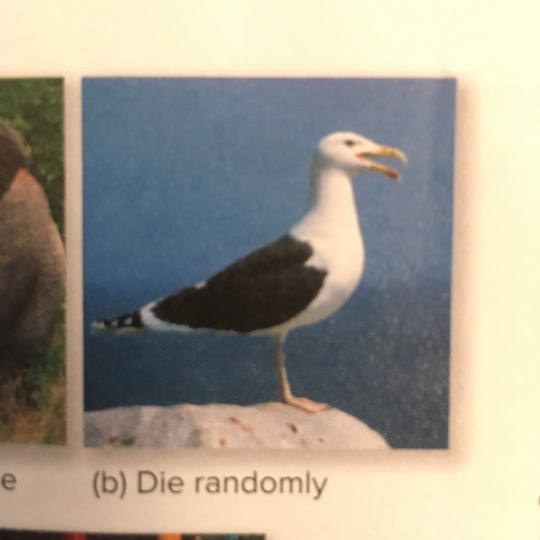
this pic from my biology textbook is way funnier than it needs to be
I hate being a bio major bc I know exactly what this stupid picture is referring to
do tell
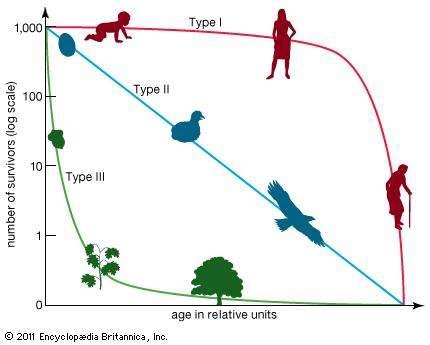
there are these things called survivorship curves and there are three types Type I (shown in red) Type II (blue) and Type III (green) They’re created by looking at birth and death rates of a given species and the curve shows at what point in time an organism of a specific species will die. For example, humans have a fairly low infant mortality and if you make it to around age 16 you’ll probably survive until you’re around 75 unless there’s an accident or you have some undetected disease that would cause you to die early. Type III are plants, fish, and other marine animals that have a very low chance of survival at birth but if they make it past infancy they will likely live to their life expectancy. Type II are birds, small lizards and mammals and they really just die randomly.
Kallima inachus or dead leaf butterfly is a nymphalid butterfly found in Tropical Asia from India to Japan. With wings closed, it closely resembles a dry leaf with dark veins and is a spectacular and commonly cited example of camouflage. (Source & Source)
i legit thought that was a dead leaf just standing up on its own
someone on the comments said “this is why some leaves don’t crunch.”
williamdrumm Thanks to @roamfor sharing this croc footage from a while back. 🤙 ・・・ Would you swim with wild crocodiles? @williamdrummdid, and calls it one of the greatest adventures of his life. ⠀ ⠀ “This is in Banco Chinchorro in Southern Quintana Too, Mexico, which is one of only a few places in the world where people swim with wild crocodiles,” he recalls. “Banco Chinchorro has one of the world’s largest populations of American Crocodiles. Crocodylus acutus can grow to over 15 ft in length and weigh more than 2,000 lbs. The crocs live in a lagoon on the interior of the island and come out of the mangroves into the saltwater to hunt. This was one of the single greatest adventures of my life—the whole experience, not just the croc diving. We stayed two nights in a fisherman’s small hut in hammocks. Handlers would call the crocs out from the lagoon right to the hut, where two people and a safety diver interact with the large crocodiles. It was calm and not particularly scary while in the water with the animals. However once I exited the water and looked at my videos, I couldn’t believe where I was minutes ago—a foot away from a wild croc with my camera running.” ⠀ ⠀ >> Video by @williamdrumm#roam247
Meet the Irukandji Jellyfish (Carukia barnesi). This tiny little fellow is deadly; believed to be the most venomous creature in the world and they are only around 2.5cm big.
Did you know that about 90% of the world’s nutrition such as fruits, nuts, and vegetables are pollinated by bees? Without the bees to pollinate our crops we will be a on shortage of food! In fact, there are more than 150 different chemical residues found in bee pollen, and the chemical industry have spent millions of dollars trying to cover up that they are not at fault. Since more grasslands and forests are converted into pesticide contaminated mono-culture-farms, bee colonies per hectare and habitat are rapidly shrinking every year.
You can help spread awareness and save the bees by donating to Greenpeace or purchasing these honeycomb necklaces where a part of the proceeds go directly to Greenpeace.
What is GreenPeace?
Greenpeace is a global non-governmental campaigning organization that aims to expose environmental problems and promote solutions via using peaceful protest and creative communication.
***You can help by purchasing a HoneyComb Necklace HERE
Read more about it at: greenpeace.org/usa/sustainable-agriculture/save-the-bees/
Save the teeny tiny flying fluff Balls!
I’m all for this I’m hoping to become a biologist of some sort and I hope to help someday


 🔥 There is beauty in destruction🔥