This little fish is a species of fish in the Syngnathidae (seahorses and pipefish) family. It is widespread throughout the tropical waters of the Indo-Pacific region, Red Sea included. It has a straight, elongated body which reaches a maximum length of 19 cm. Similar to other seahorses and pipefishes, the male banded pipefish is equipped with a specialised brood pouch, rather than the female. The female deposits her eggs in the male’s pouch, where they develop. The male later gives birth.
Horses flip out and run even though there’s nothing there to spook them
This is why when I got on a pony, and mind you I had never once ridden in my entire life, and this pony, I thought it was a horse. At least, I thought it was pretty big. I was excited, but also so freakin scared that at any moment it would freak out with me on it. It wasn’t even actually to ride rather a show where kids can get on and honestly I weigh nothing and am small, so the owners let me. Lol.
Sadly, I couldn’t last the entire duration cause was too scared and really just thanks anxiety.
After taking its prey into its beak, the shoebill opens its bill just enough for its victim to poke its head out. Then, the shoebill clamps down again with its knife-edged beak and decapitates the thing before swallowing it whole.
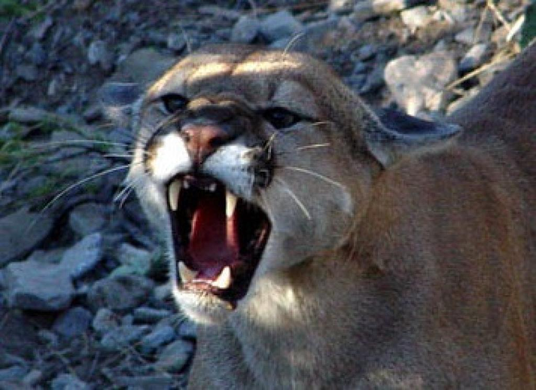
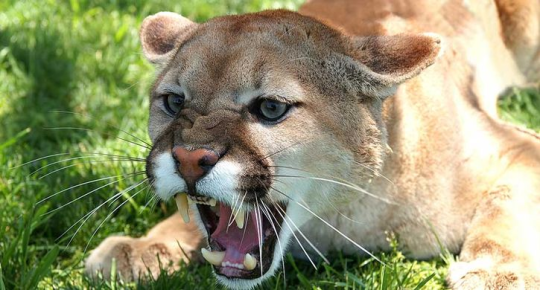
I grew up in mountain lion country, and it came to my attention today that 1) this information is far less common knowledge than I thought and 2) a lot of the things you are supposed to do in a cougar attack run contrary to the advice given for other land animal attacks (ex. play dead, try to appear nonthreatening, don’t make eye contact).
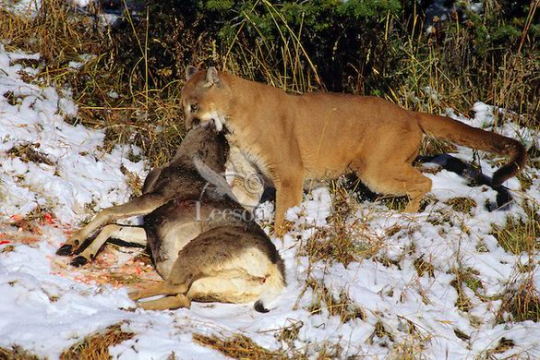
Disclaimer: Most cougars do not want to eat you and will go to great lengths to avoid even being seen by humans. My hometown is chock full of mountain lions (we once had a lion cache a deer carcass in our yard) but I have only seen a wild lion once in my entire life; they really avoid people.
Mountain lion attacks are exceedingly rare and are usually carried out by sick or starving animals. You are more likely to be killed by a dog, bee sting, or lightning strike than a cougar.
Rule #1: Do not run, but don’t freeze either
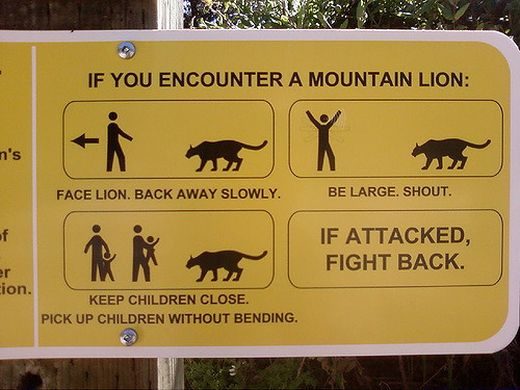
Do not, do not, do not run from a cat. Running triggers the chase instinct. Running means prey. I know running is a basic instinct in scary situations for many of us, but you have to resist it. Your best bet is to back away slowly until far away from the cougar. Then you can run.
Some people take the “don’t run because it triggers the chase instinct” too far and don’t move at all when they see a cougar. This isn’t good either, as it is similar to the panicked freeze-mode of some prey animals and may suggest to the lion that you aren’t capable of fleeing or fighting back (or that you don’t notice its presence). Stare down the mountain lion, make it clear that you see it, and slowly leave the area.
As you leave look around and make sure that you aren’t between a mountain lion and its prey cache or kittens. Also make sure you aren’t cornering the cat and that it has an escape route.
Rule #2: Do not turn your back
A lion’s preferred means of hunting is to leap onto its prey’s back and either break the neck or get a good enough grip to suffocate the animal. Do not give the cat an opportunity to do this by turning your back.
Also if a cat advances towards you and acts threatening but eventually backs off, do not relax. Cougars are ambush predators and the cougar very well could have backed off so it can hide and regain the element of surprise. Keep looking all around as you leave the area, don’t give it a chance to sneak up behind you.
Rule #3: Be as scary-looking as possible
Do make eye contact. Do act scary. Do make yourself look as big as possible (open your jacket, square your shoulders, wave your arms, group together with other people, pick up and hold small children, lift your backpack above your head, etc). If you have a weapon like a tree branch or hiking pole wave it around.
Make loud noise, but do not scream or make high, jerky sounds. You don’t want to sound like the alarm call of a panicked deer or other prey animal. Bang your water bottle against a tree, smack hiking poles together, shout in a steady and non-high-pitched voice.
If the cat is advancing towards you throw rocks or sticks if you can, but avoid crouching down to grab projectiles as much as possible as this makes you look smaller and gives the cat a window to attack.
You want to convince the lion that you will f*ck it up if it comes after you. Do whatever it takes to make yourself look confident and scary. If the lion is still advancing towards you at this point you need to be mentally preparing yourself to fight.
Rule #4: If a cat attacks you do not stop fighting
Do not play dead, playing dead only works when an animal is attacking you out of defensiveness or territoriality. An attacking lion wants to eat you, and if you play dead it will happily drag you away and begin its meal.
If you stop fighting you are dead. If a cat grabs someone in front of you and you don’t fight the cat off, they are dead.
Yell if there are other people in the vicinity, but if you leave someone being mauled to get help that’s more than seconds away you are probably leaving them to their death.
You don’t have to beat the cat in a fight, you just have to convince it that humans are made of pain and that continuing to attack will be more risky than it’s worth. Use sticks, rocks, water bottles, hiking poles, etc. Go for sensitive areas like the eyes and the nose. Protect your head and neck as much as possible.
Safety precautions in mountain lion country:
-Travel in a group
-Try to avoid biking, hiking, or jogging at dawn and dusk. This is a cougar’s preferred hunting time (and if you do definitely go in a group)
-Do not let small children or pets out of eyesight (particularly at dawn and dusk). The vast majority of mountain lion attacks target small children or pets.
Disclaimer #2: This post is not meant to cast blame in any way on victims of mountain lion attacks that did not follow these rules. Even when you know what to do it is extremely difficult to keep a clear head and resist the instinct to flee when faced with a large predatory animal. One should never judge someone for how they reacted in a terrifying, unpredictable life-or-death situation.
Ok but there are places people live where you could literally encounter a mountain lion almost ANYWHERE. Walking home from school. Outside your house as you get out of the car. At the park where you walk your dogs. Are you gonna carry a gun with you EVERYWHERE?
Or even if you’re just visiting mountain lion country are you gonna want a gun bouncing around on your hip while you’re out for a jog in just athletic wear or when you’re mountain biking and might fall on said gun?
Considering the extremely tiny chance that a mountain lion will attack you, even when there are lots of them around, carrying a gun every time you’re in mountain lion country is a massive and hugely impractical overreaction.
As someone who hikes in mountain lion/bear/coyotes/rabid animal/nature that wants to eat you territory than it is wise to carry a gun with you hiking and also carry bear spray. When jogging in the woods carry a large pocket knife. But most importantly it’s best to know what to do when you stumble upon these animals and only use weapons as a last resort unless its rabid animals and venomous snakes like water moccasins that are assholes and will chase you if you get to close.
The image at the left is a remarkable find from Cretaceous-aged amber in Myanmar; a tiny, few centimeter wide, newborn (or possibly embryonic) snake fossil. This photo was just published in an article introducing this 100 million year old fossil to the world; the picture on the right is an X-ray image that shows the bone structure of this fossil.
Turtles cry tears that attract butterflies so that when the butterflies settle on the turtles head to drink the tears the turtle will eat them.
That took one hell of a turn…
Lmao. I just looked this up and the Butterflies do drink the turtle’s tears, idk about turtles eating them tho. Apparently tho, their are countries that actually have butterflies as desert!
The black swan (Cygnus atratus) is a species of swan, which breeds mainly in the southeast and southwest regions of Australia. The species was hunted to extinction in New Zealand, but later reintroduced. (Source)





 🔥 There is beauty in destruction🔥