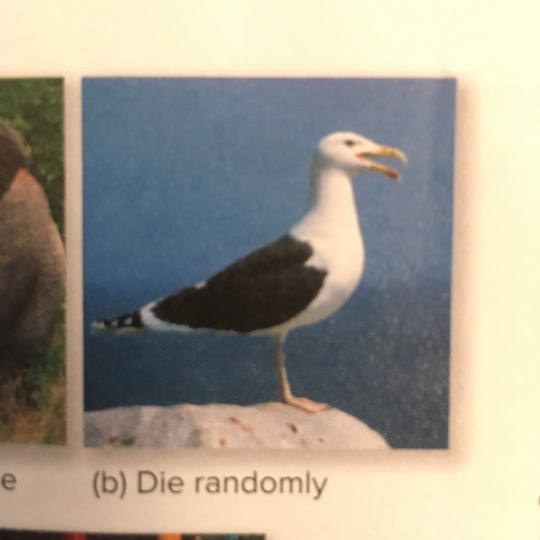
this pic from my biology textbook is way funnier than it needs to be
I hate being a bio major bc I know exactly what this stupid picture is referring to
do tell
there are these things called survivorship curves and there are three types Type I (shown in red) Type II (blue) and Type III (green) They’re created by looking at birth and death rates of a given species and the curve shows at what point in time an organism of a specific species will die. For example, humans have a fairly low infant mortality and if you make it to around age 16 you’ll probably survive until you’re around 75 unless there’s an accident or you have some undetected disease that would cause you to die early. Type III are plants, fish, and other marine animals that have a very low chance of survival at birth but if they make it past infancy they will likely live to their life expectancy. Type II are birds, small lizards and mammals and they really just die randomly.
This little fish is a species of fish in the Syngnathidae (seahorses and pipefish) family. It is widespread throughout the tropical waters of the Indo-Pacific region, Red Sea included. It has a straight, elongated body which reaches a maximum length of 19 cm. Similar to other seahorses and pipefishes, the male banded pipefish is equipped with a specialised brood pouch, rather than the female. The female deposits her eggs in the male’s pouch, where they develop. The male later gives birth.
The lungfish, also known as salamanderfish, is a type of freshwater fish best known for its ability to live on land, without water, for months on end, and sometimes even years. As its name suggest, the lungfish have a highly evolved respiratory system that can take oxygen straight from the air, just like land animals do. In fact, some species of lungfish are so used to breathing air that they slowly lose the function of their gills as the fish approach adulthood. While they still live in water, they need to regularly come up to the surface for air. These fish can even drown if they are held underwater for a long time.
When there is water, the lungfish behaves like any other fish, swimming in the waters and eating small fish and crustaceans on the bottoms of ponds and streams. But when the dry season hits, the lung fish burrows itself deep into the mud, digging out a path by taking mud into its mouth and forcing it out its gills. After the fish has reached a comfortable depth, it will stop digging and secrete a mucous out of its skin that hardens to form a protective cocoon around it. Only the mouth is left exposed for breathing. For its long hibernation, the lungfish will greatly reduce its metabolism and live off the muscle tissues in its tail. Once the water returns and the mud softens, the lungfish will wriggle out of its burrow. Some reports claim that the fish can stay underground in dried mud for as long as four years. (Source)
Fisherman Catches A ‘Giant Piranha’ (Goliath tiger fish)
Jeremy Wade, host of Animal Planet’s “River Monsters” has made the catch of the century on a stretch of the River Congo. This prehistoric looking creature is 5 feet long and weights approximately 100 pounds (more than 50 kg) but what shocks us the most, are this giant piranha’s teeth, 32 razor-sharp teeth to be more exact. The amazing size of these fangs is mostly common in great white sharks, so if you were thinking small piranhas are dangerous and creepy, think again, cause this monster exists for real, and it’s got the teeth of a shark.
Fortunately, they only live in a remote part of Africa along the Congo River, a place which is very hard to reach for outsiders, and even for the locals.
Goldfish (Carasius auratus auratus) are one of the most popular aquarium fish. Unfortunately, this is because people are lead to believe that they can be kept in small aquariums or, even more popular, fish bowls. These bowls are unsuitable for almost all fish. Keeping a goldfish in one will result in it’s premature death. There are many varieties of goldfish, but they can be split up into two different groups. Fancy goldfish and common goldfish. Fancy goldfish do not get as large as commons, therefore they are more suitable for tanks. Goldfish also do not make good children’s pets because of the large amount of space and maintenance they require. So here are some myths about them and their care that are dangerous to the life of your fish.
Myth #1: Goldfish will only grow to the size of their bowl.
Truth #1: Goldfish will grow to the size of their tank, becoming stunted and unhealthy.
Stunted fish live short, unhealthy lives. You never want to stunt your fish. So this myth has a little but of truth to it. When a goldfish is put into a bowl, it is creating too much waste for any water change schedule to keep up with. There are a few theories around goldfish and why some are stunted when kept in small bowls and tanks. One theory says that because it has no room to grow, it releases hormones that make it grow slower, stunting it’s growth. Another is that a build up of nitrates are the cause. Either way, the fish will die either due to being exposed to deadly amounts of it’s own waste before it can reach a certain size, or is stunted living a shortened lifespan. Both of those deaths are easily preventable with proper care.
Truth #2: Goldfish have a 2 month memory span, possibly even longer.
This myth has no scientific backing. There have been countless studies involving goldfish and their memory. Goldfish have a normal memory span, they can remember their way through a maze for months; and if the maze is changed they can find their way through with minimal problems.They also associate objects or actions with events like feeding, and can even be taught tricks!
Myth #3: Goldfish do not make a lot of waste, and do not get very large so they are suitable for a small tank.
Truth #3: Goldfish make a lot of waste for their size, and some get around a foot long! They are only suitable for large, well filtered aquariums.
This could not be further from the truth. A full grown common goldfish is around 12-20 inches long. A full grown fancy goldfish is 5-12 inches. These are not small fish. If they do not reach their adult size, as with all animals, something went wrong. Goldfish make a lot of waste for their size, therefore they require large volumes of water and frequent water changes with a strong filter. A single common goldfish should be kept in a minimum of a 100 gallon tank as an adult. A single fancy goldfish should be kept in a minimum of 20 gallons. Sometimes it is hard to get people to believe that they reach such lengths, but when kept properly they can and should get to be quite large. Therefore, keeping them in a bowl is unacceptable if you value their life. It is extremely unfortunate that this myth is so well known- and believed.
Truth #4: Goldfish are long lived animals, they should live to be 15-25 years old.
This myth also has no truth to it. It’s the exact opposite of what is true. The longest lived goldfish on record died at the age of 43! Now, that doesn’t mean your goldfish will live that long, but they still live for quite a while. The average goldfish lives for 15-20+ years. That is about as long as a dog or cat. Therefore, when purchasing a goldfish, you must think about whether or not you will be able to care for it during it’s whole life. It’s not something to be taken lightly. A lot of people complain about their goldfish only living for a few weeks or months. This usually happens because the goldfish is kept in a bowl.
It is recommended to use a filter for twice the volume of water the fish is actually in. Goldfish are notorious for making waste. When dealing with goldfish, you want to get a filter for a tank twice the size of the tank the goldfish are in. Anything less and you will have problems keeping waste levels down. When a goldfish is alive, it creates waste 24/7. As a fish exhales, they exhale ammonia. They also release waste into the water. This ammonia builds up pretty quickly, and it is your job as the owner to make sure it does not get to dangerous levels. A goldfish in a bowl can create enough waste to make the water dangerous to live in within a day! After being exposed to this dirty water, the fish becomes stressed and ill. It will then die if the water is not cleaned. It is impossible to keep a small tank clean enough for a goldfish to live in it and be healthy for 20 years. Therefore making bowls not even an option.
Truth #6: Goldfish are cold water fish, preferring temperatures of 65-70 degrees Fahrenheit.
Goldfish are descended from Prussian Carp, a cold water carp living in parts of Asia. While goldfish can tolerate a wide range of temperatures, keeping them in warmer water can speed up their metabolism and stress them, making it a poor temperature to be kept at. Goldfish thrive at 65-70 degrees Fahrenheit (18-21 degrees Celsius). Common goldfish can be kept in cooler temperatures during the winter like koi, but fancy goldfish do not tolerate it well.
In conclusion, goldfish should never be kept in bowls. They get too large, they need strong filtration, and they make too much waste to be kept in something small. Keeping a goldfish in a bowl will kill it. Keep in mind that even if a goldfish lives for 5 years in a bowl, it still didn’t live to half of it’s expected lifespan. If you truely value the life of these living, feeling creatures you will do research before purchasing them and give them an acceptable place to live and level of care.
General goldfish information sources and good reads:
The “lizard fish,” or the bathysaurus ferox, is one of the latest deep sea discoveries, pulled out of a fishing net this past summer in Australia. It has a long, eel-like body and a flat head with triangular jaws full of sharp teeth that resemble a lizard, thus the name. The teeth are hinged, and drag any prey in it’s mouth deeper in the more it struggles.
No more grainy poster thanks to kai-ni! You’ll still need to contact me for the full, printable version. Unfortunately it’s so large that it causes color issues if not resized slightly. But now I can offer it in .png as well!
Hope you guys enjoy! 😀 Pass it around/reblog so it can catch some eyes maybe. 🙂 Help out some fishies and owners.
It can always happen, but there are some things you can do. Some things are a little more far-fetched but for people who keep extremely expensive fish or shrimp it’s definitely a must:
– High quality heaters. I personally love Eheim Jäger
– Get two heaters and set one to a temperature one degree below the other. If the “main” one fails, the other one will take over and your fish won’t die from the cold.
– Use an external thermostat. I don’t have experience with this, but these are available in many places and will shut off the heater if it goes rogue.
– Place the heaters outside of the tank. For people with a drip system this is easier than for regular aquarists, but some canister filters do have room for a heater. In case of explosion, your fish will be a little safer.
I’m sure there are more things that I’m not thinking of right now. But these should definitely help! 😊





 🔥 There is beauty in destruction🔥