Cancer is caused by mutations in DNA inside a cell, but not all DNA mutation leads to cancer. The cell has very effective mechanisms for repairing DNA damage, and it’s when these go wrong that cancer occurs.
Thing that causes DNA mutation = mutagen
Mutagen that causes cancer = carcinogen
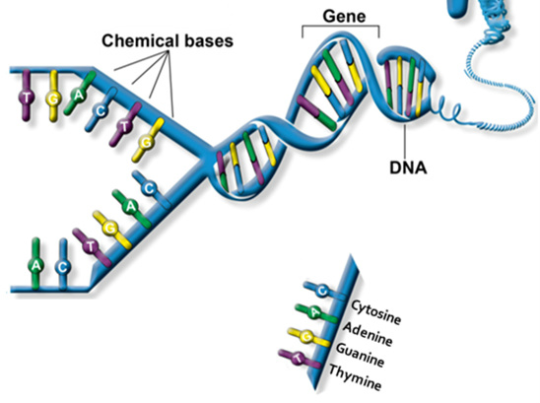
DNA is a sequence of bases that can be read like code. A group of bases, in the right order, code for a protein and make up a gene. If only one thing is in the wrong place or cut out, the protein won’t be made correctly. This can lead to a number of pathologies, including cancer.
What can cause this damage?
Exogenous/environmental
Chemical – eg tobacco smoke, fibres, pollution
Physical – eg ionizing radiation or UV light
Endogenous (inside the body)
Spontaneous mutation
By-products of metabolism
Types of lesions (area that has suffered damage)
[Post coming soon covering how exogenous and endogenous factors cause this damage!]
Missing base eg removal of purines by acid and heat; removal of altered bases (e.g., uracil) by DNA glycosylases
Altered base egnIonizing radiation; alkylating agents (e.g., ethylmethane sulfonate)
Incorrect base eg mutations affecting 3′ → 5′ exonuclease proofreading of incorrectly incorporated bases
Bulge due to deletion or insertion of a nucleotide – Intercalating agents (e.g., acridines) that cause addition or loss of a nucleotide during recombination or replication
Linked pyrimidines – Cyclotubyl dimers resulting from UV irradiation
Single- or double-strand breaks – breakage of phosphodiester bonds by ionizing radiation or chemical agents (e.g., bleomycin)
Cross-linked strands eg covalent linkage of two strands by bifunctional alkylating agents (e.g., mitomycin C)
3′-deoxyribose fragments – Disruption of deoxyribose structure by free radicals leading to strand breaks (source)
These lesions will then be recognised by the normal damage and repair mechanisms of the cell. If this mechanism is impaired, it may miss some lesions.
DNA damage is recognised by sensor
Signal transmitted to ATM/ATR (kinases that phosphorylate proteins to initiate activation of the DNA damage checkpoint)
Transmitted via adaptors/transducers
Endpoint. If the damage is too severe the cell will perform apoptosis (’cell suicide’) and destroy itself in a controlled manner. In areas like the liver the loss of a few cells will likely not be damaging, but losses from eg neuronal systems can have a far more pronounced effect.
DNA Repair
Mismatch repair: occurs immediately after DNA synthesis, using the parental strand as a template to correct – a short section containing an incorrect base is identified, removed, and replaced by DNA synthesis directed by the correct template
Excision repair: removesa damaged region by specialized nuclease systems and then uses DNA synthesis to fill the gap.
Double-strand breaks can be repaired by homologous recombination and by an end-joining of nonhomologous DNA duplexes.
DNA repair, therefore, protects against cancer, however these mechanisms are far more error prone than initial DNA synthesis -therefore directly causing mutation. This means the DNA wasn’t ‘put back together’ correctly, so the code of bases isn’t correct. The cell then copies this erroneous code, with potentially devastating effects. DNA damage is occurring in everyone all the time. The older the person, or the more exogenous effects they’re exposed to, the more damage events will have occurred and therefore the higher the probability of error in repair. Limitations in repair mechanisms mean that if humans lived long enough, they would all eventually develop cancer.
If the lesion is not repaired correctly, it doesn’t always cause adverse effects (silent mutation). Any adverse consequences will vary depending on the type, number, and location of cells involved; and if the targeted cell is part of a dividing or non-dividing population.
Defects in repair mechanisms can be genetically inherited, meaning that a person has a genetic predisposition to certain types of cancer.
During World War 2, one B-17 Bomber cost a little over $200,000 to produce. That’s about $3,4 million in today’s economy. And since the US Army requested thousands of these planes, they wanted to take every measure when securing the Boeing factory that produced them. And by “every measure” I mean hiring Hollywood set designers to build a fake neighborhood atop it and getting actors to inhabit the area.
Protecting it from potential air strikes, the “neighborhood” was constructed in 1944 and removed a year after the war. John Stewart Detlie was the Hollywood set designer who helped to hide the Boeing Plant No. 2. Using the same techniques as in the movies, fake streets, sidewalks, trees, fences, cars, and houses were set in place to fool the would-be attackers.
Underneath it, 30,000 men and women were constructing about 300 bombers per month to support the fight against Nazis. Boeing B-17 Flying Fortresses dropped over 640,000 tons of bombs over Germany alone during the conflict, and of the 12,731 aircraft built, about fifty remain in complete form. (Source)
An aspect of gun control that other countries practice that doesn’t come up in America a lot is ammunition control. In Japan, if you’re one of the privileged few allowed to own a gun (and only shotguns and rifles are legal), you have to return all your spent cartridges if you want to buy any more. In Israel, after you’ve purchased the one gun you’re allowed to own, you’re given a box of 50 bullets, and that’s it. You can’t buy any ammunition anywhere, that’s your lifetime supply, although a shooting range will provide you with more, but only for use at that range. Even in countries with more relaxed gun control laws, like Switzerland and Serbia, buying ammunition requires all the same paperwork as buying a gun (mental health records, criminal records, etc) and you can only buy ammo for the gun you own. Gun control advocates in the US should consider placing an emphasis on ammunition control in addition to everything else.
How does this even happen? Like are these cause naturally or did a human/manmade thing cause this?
Dolphins can make them, I learned to do it, it’s a lot of fun. Just a way of pursing your lips when you blow bubbles
Life is amazing
toroidal vortexes!! they’re basically a tube rolling, but the tube is a circle. The rotation direction is inward or outward, instead of clockwise or counterclockwise like a “normal” vortex! You can make them by creating a cylindrical current of faster moving fluid around a similar current of slower moving fluid, aka pursing your lips when you blow bubbles!
WARNING: material you are about to see contains upsetting content and images of said bodies. They are not gorey so don’t worry. But if you do not wish to be exposed to this scroll down really fast right now. This is your chance. GO GO GO
Did you know that there’s a certain height (26K ft) up, where climbers have to decide whether they should rest or continue on.
Those that chose to go up must go up there and back fast enough, because at that high of altitude necrosis sets in (cell injury) and there body is literally DYING.
So they gotta get back fast enough before their body shuts down.
Here are some of the bodies:
The body of David Sharp still sits in a cave at the top of Mount Everest.
David attempted the climb in 2005 and near the top, stopped in this cave to rest. His body eventually froze in place rendering him unable to move.
Over 30 climbers passed by him as he sat freezing to death. Some heard faint moans and realized he was still alive. They stopped and spoke with him. He was able to identify himself but was unable to move.
Brave climbers moved him into the Sun in an attempt to thaw him but eventually, realizing David would be unable to move, were forced to leave him to die. His body still sits in the cave and is used as a guide point for other climbers nearing the summit.
The body of “Green Boots” (an Indian climber who died in 1996) lies near a cave that all climbers pass on their way to the peak.
Green Boots became separated from his party in 1996 and sought this mountain overhang (really a small, open mouthed cave) to use as protection from the elements. He sat there shivering in the cold until he died. The wind has since blown his body over.
Francys Arseniev, an American women who fell while descending with a group (that included her husband), pleaded with passerby’s to save her.
While climbing down the side of a steep section of the mountain, her husband noticed she was missing. Knowing that he did not have enough oxygen to reach her and return to base camp, he chose to turn back to find his wife anyway.
He fell to his death in the attempt to climb down and reach his dying wife. Two other climbers did successfully reach her but knew carrying her off of Mount Everest was not an option. They comforted her for a while before leaving her to die.
Feeling great remorse, they returned eight years later vowing to find the body and enshrine it in an American flag (they succeeded). After details of the disastrous climb became known, it was realized that Francys Arseniev had become the first woman from the United States to reach the summit of Mount Everest without the aid of bottled oxygen.
These are just 3 of the many bodies out there.
You can read more about the others, get more information and know where I got this information from here
I’ve been reading Into Thin Air by Jon Krakaeur and it’s a non ficton memory based novel about his journey on Everest and it really humanized the experience. So many people hear about people climbing Mount Everest and don’t understand the strain of just surviving day by day
You might find it hard to believe A Nightmare on Elm Street (1984) was based on a true story. The narrative device of Wes Craven’s slasher film, in which knife-for-fingers Freddy Krueger (Robert Englund) kills innocent teenagers in their sleep, is entirely fictionalized. However, Craven based the movie on an Los Angeles Times article he read.
Craven described the idea for the premise of A Nightmare on Elm Street:
“I’d read an article in the LA Times about a family who had escaped the Killing Fields in Cambodia and managed to get to the U.S. Things were fine, and then suddenly the young son was having very disturbing nightmares. He told his parents he was afraid that if he slept, the thing chasing him would get him, so he tried to stay awake for days at a time. When he finally fell asleep, his parents thought this crisis was over. Then they heard screams in the middle of the night. By the time they got to him, he was dead. He died in the middle of a nightmare. Here was a youngster having a vision of a horror that everyone older was denying. That became the central line of Nightmare on Elm Street.”
This is the very weird aftermath of a 2010 toxic waste spill in Western Hungary. A reservoir holding an aluminum company’s toxic waste burst in October 2010, sending a million cubic meters of deadly sludge into surrounding towns and countryside.
What’s in the sludge
Bauxite, the raw material from which aluminium is processed, contains a mix of minerals, including aluminium, iron oxides and titanium dioxides. It is dug out of the ground and washed with hot sodium hydroxide as part of the Bayer process, invented in the 19th century. This extracts the aluminium oxide, or alumina, from the ore that is subsequently used to produce pure aluminium. The waste, known as red mud, is a mix of solid impurities, heavy metals such as cadmium, cobalt and lead, and the processing chemicals. The caustic mixture can burn skin on prolonged contact and is an environmental liability, difficult to store. Red mud is also classed as a “technologically enhanced, naturally occurring radioactive material” – a substance produced when processing of raw materials concentrates or exposes radioactive materials. Alok Jha


 🔥 There is beauty in destruction🔥